


Why should I stage my home before selling?
Why should I stage my home before selling?
The main reason to stage a home is ROI. About 75% of sellers see an ROI of 5% to 15% over the asking price. If spending a few thousand on staging can lead to tens of thousands in returns – it’s often a no-brainer for agents or owners to implement staging as a part of their marketing process.
Read more about the ROI of staging here.
What does the staging process look like?
What does the staging process look like?
Our staging process includes the following steps:
- Inquiry: You reach out to us via phone call, text, or our contact form about a staging project. We will then discuss the project details, proposed pricing and terms. Once we are aligned, the next step would be to sign a simple agreement and agree on payment method.
- Walkthrough: We always come to visit the property in person to take measurements and photos/videos. This visit can take between 30-45 minutes, depending on the size of the property. During this visit, we are also happy to provide you with recommendations on preparing the property for sale if that’s of interest (i.e. painting updates, light fixture changes, etc.).
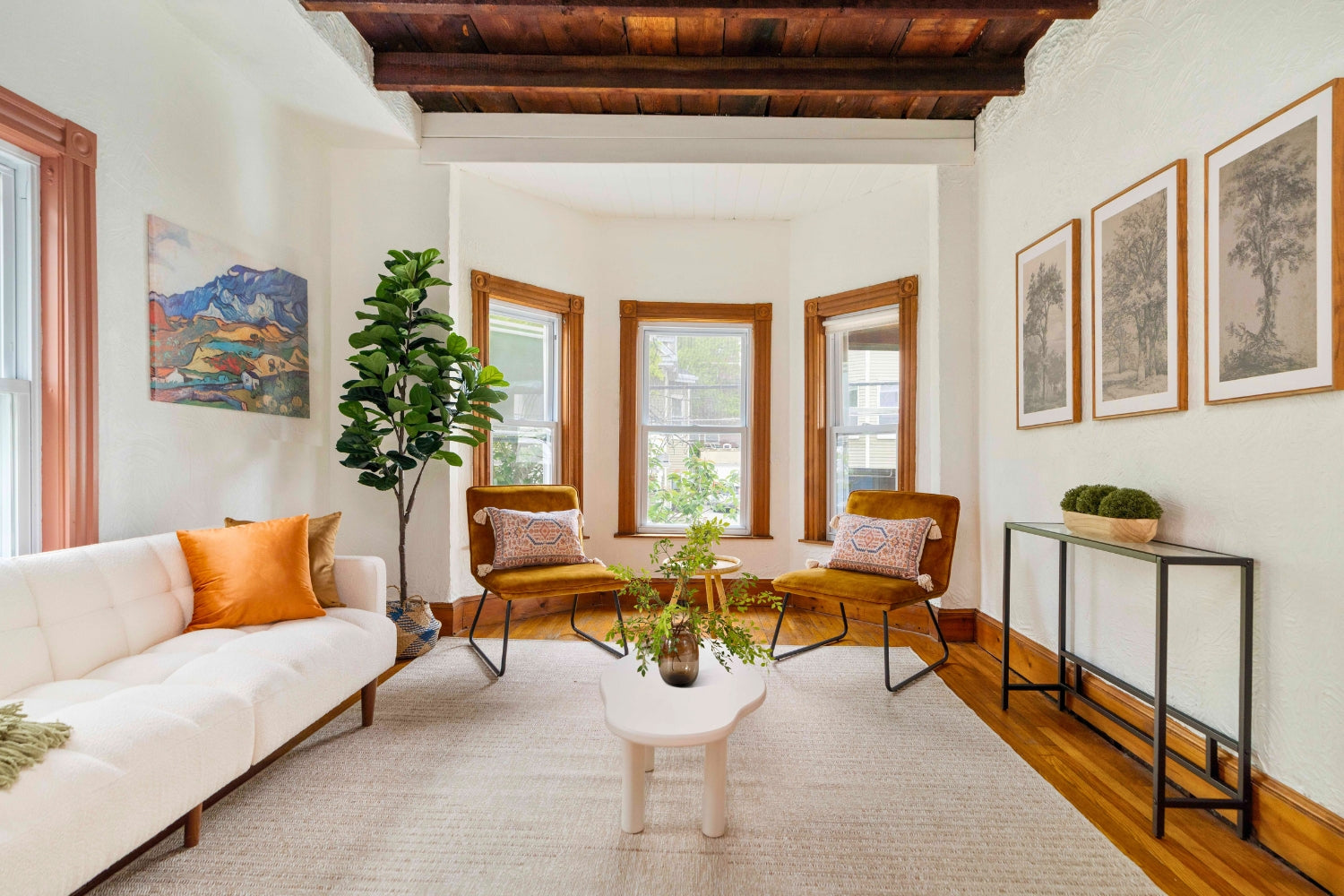
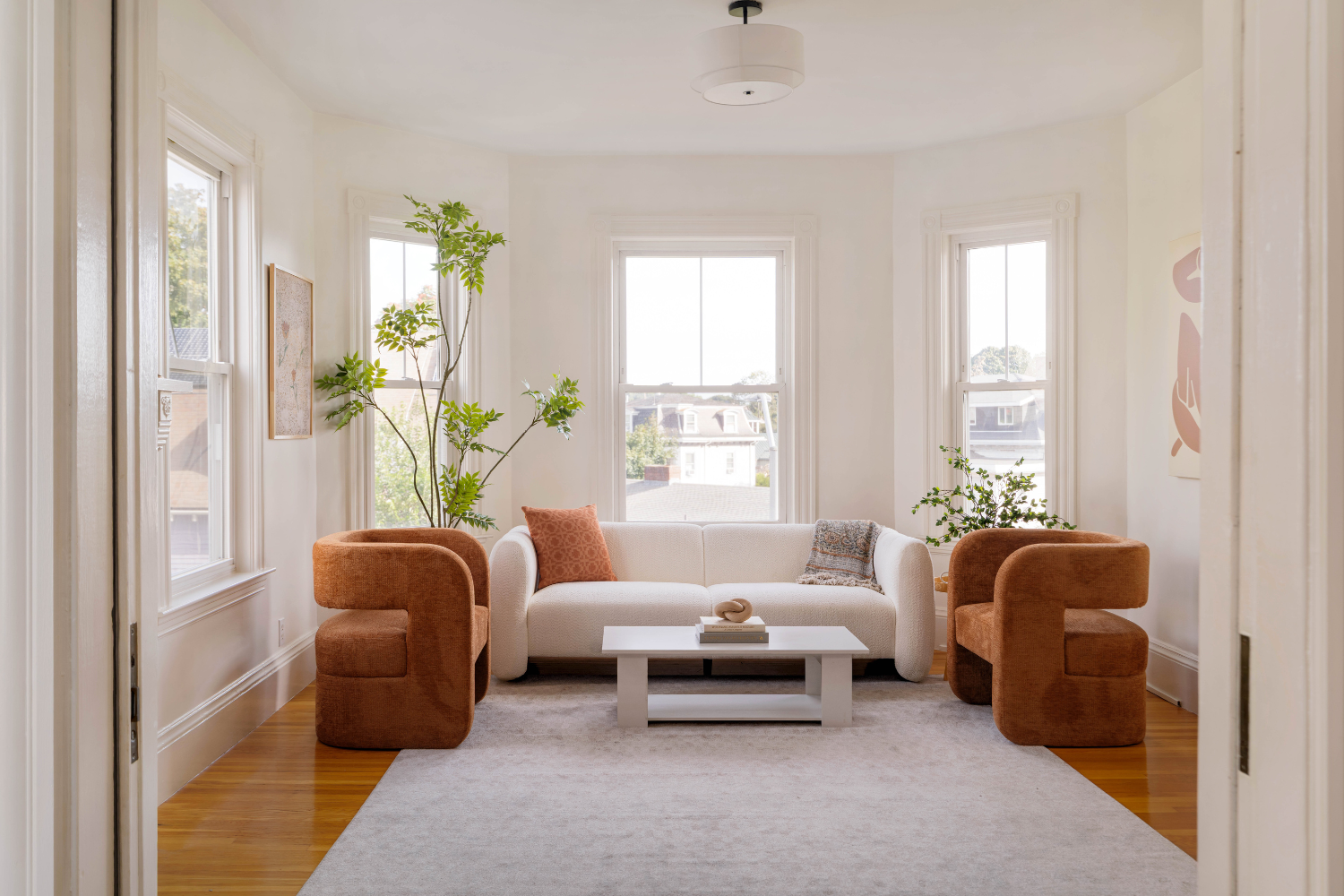
- Design: Based on our in-person visit, we will carefully select furnishings, décor and artwork that will uniquely complement your property. Our high-end furnishings and large-format, custom manufactured artwork will both update and elevate your property. The result will lead to beautiful photography and an experience that will truly wow buyers.
- Installation: We will mutually agree on a staging installation date. Our goal is to be flexible and to make the experience as stress free as possible for you. Our staging process typically takes several hours, and in most cases will be completed in a single day.
- Removal: We will then remove the staging on a mutually agreed upon date. Our hope is that you were able to leverage our staging and sell your property for the
highest price and best terms!
What areas do you serve?
What areas do you serve?
We serve a wide range of towns and suburbs in the Greater Boston area. Below is a sample list of towns where we do a lot of work:
If you are curious about whether your project is in a location that we serve, don’t hesitate to reach out to us anytime and ask! Email me at marissa@baanhome.com or call at 248-390-4221.
Do you stage luxury homes?
Do you stage luxury homes?
Yes! We do offer staging services for luxury homes in the Greater Boston area. To read more about luxury staging services, click here.
How far in advance should I book a staging?
How far in advance should I book a staging?
It’s usually ideal to reach out to us at least 2 weeks in advance to schedule a staging. However, we want to be as flexible as possible, as we know that planning for a sale isn’t always a predictable process. So we recommend that you always reach out to us, even if it’s last minute. If we have the inventory and the time, we have the ability to stage a property with just a handful of days’ notice.
What is the minimum staging period?
What is the minimum staging period?
Most of our staging agreements allow owners to keep our staging in place for up to 60 days. After that, there is a monthly renewal fee if you wish to keep our staging in place for longer. Of course, we are also happy to remove the staging before 60 days is up – we will just mutually agree on a date for the de-staging process to occur.
What are some common misconceptions in staging?
What are some common misconceptions in staging?
Staging is just decorating.
Decorating is undoubtedly a part of what staging entails. However, what stagers actually do is provide a marketing service. Stagers need to know what types of interior design will resonate in their market. They also need to know how this might differ by town and property type. The interior design that works for Miami might not work for Cambridge – and the interior design that works for Cambridge might not work for Wellesley. And the interior design for a Cambridge condo might differ from Cambridge single family. When you are hiring a stager – you are hiring someone who knows what buyers are interested in each property, and they are custom designing a space that will excite and motivate those specific buyers.
Only expensive or luxury homes need staging.
When you’re scrolling on Instagram, stagers often market the most high-end or luxury homes they’re staging. This is understandable – who doesn’t want to see a mansion with high-end finishes and incredible furniture? And while we do have a lot of experience staging luxury homes, staging can be just as impactful - if not more so – for smaller, less luxury spaces. In our market, those smaller homes, condos and apartments can often go for $1M+, but these properties often fade into the Zillow void if they are not staged, simply because buyers are more likely to skip over pictures of small empty rooms. Those same rooms can look stunning with the right staging and art – which in turn is likely to net the seller tens of thousands more in gains. Sellers and agents just need to understand how the impact staging extends to every property, especially the “less exciting” ones. At Baan Home, we are proud of our ability to make smaller, more dated spaces feel exciting and new. Feel free to check out some of our smaller staging projects in these case studies.
Staging is too expensive to be worth it.
Our pricing begins at $2850 for a small one-bedroom condo and can go up from there. Sellers will often see the price tag of staging and get overwhelmed. Selling a home is already a stressful process, often with other fees involved – so it’s understandable if you don’t want to add another cost to the mix. I think the important part here is to understand the ROI of staging. If as a seller, you understand that staging is likely to lead to strong returns (often in the tens of thousands of dollars) and cleaner terms - then paying for staging become a no-brainer. In practice, we have seen staging pay off in markets that favor sellers and markets that favor buyers, as well as during the busy season and the off-season. Staging will always help you put your best foot forward from a marketing perspective – which will help you obtain top dollar no matter the environment around you. For more information on the benefits of staging read here.
Buyers prefer a blank canvas.
We often hear sellers say that buyers would prefer to use their imagination when walking through a new property. And this is undoubtedly true for some buyers. However, it’s not for most. Most buyers in fact STRUGGLE to use their imagination. They struggle to visualize furniture and art placement and décor choices. Staging gives them a starting point to see how a space can be used – and it removes the mystery behind questions like:
- “Can a full-size bed actually fit into this room?
- “Would I be comfortable working from home in this room?”
- “Would we ever be able to invite more than 1 person over to sit in our living room with us?”
- “What would we even do with this extra space?”
Since the design vision is in front of them and the mystery is removed – buyers can more easily imagine how they might tweak the space and make it work for them. They can then more quickly move on to the next step – which is thinking about the price and terms of a potential offer.
Minimalist, neutral staging is the best.
We often hear that a neutral, minimalist, “blank canvas” staging is what works best. And that maybe is true in some markets and some scenarios. However, we have found that in the Greater Boston market, this is often not the case. Buyers in this area tend to be diverse, global, educated and upper income. They appreciate history (which this city is of course steeped in) and other cultures. When it comes to interior design, this often translates to a love of houses full of character. Buyers in our market appreciate modern and updated furnishings – but they also love seeing color, unique décor pieces, and high-end art in a mix of styles. At Baan Home, we specialize in creating spaces with the furnishings and unique art pieces to create this warm, “lived-in” design effect. Feel free to check out our gallery to further understand the aesthetic that works so well in the Greater Boston market.
Virtual staging is enough.
Some believe that staging is only for photos, and that virtual staging will give sellers comparable benefits at a fraction of the cost. We do think that virtual staging, when done really well, can have a positive effect in drawing views on Zillow and other platforms. That being said, if you are truly trying to obtain top dollar, then virtual staging unfortunately does not have anywhere near the same returns as real-life staging. Like I mentioned above, virtual staging can draw in more online views (though even the best virtual staging often has an artificial effect) – but the most powerful part of the staging process comes in-person. Buyers don’t make their decision based on photography – they make their decisions on how they feel when they walk into a home. That feeling can only be created through a real-life, non-digital experience that keeps buyers at the property, making it more likely for them to consider an actual offer.
All rooms need to be staged.
In many cases, it can make sense to completely stage a property. This often makes sense for condos, apartments, and smaller homes. However, for larger homes with many bedrooms, a complete staging might not be necessary. The most impactful rooms to stage would be the main living room, dining room, kitchen, primary bedroom, and any tight/funky rooms where buyers might have a tough time imagining how that space can be used. These are the spaces that buyers need most help envisioning. They also will make for the most impact on Zillow (where there is an initial grouping of several photos that a buyer will see on a property) and in-person (when they first walk into the property). If you are curious about what rooms we recommend staging, or if you would like a quote for a subset of rooms in a property, feel free to reach out to us anytime through phone, text, email or our contact form.
All staging is the same.
Many agents or owners see staging as a commodity, and they will proceed to price shop across multiple staging companies – with price being the determining factor in choosing a stager. The truth is that staging varies widely from one stager to another – and the differences between stagers can really impact the ROI that an owner will get upon selling their property. Price differences often reflect varying quality in furniture, art, décor, and overall service. We recommend closely looking at these factors when selecting a stager, as they will often play a bigger role than price in determining the final impact and return of the staging service selected.